The current war in the Middle East is beginning to generate various repercussions across the global economy, but none as immediate and far-reaching as the negative impact on international air commerce. For more than ten days, the Persian Gulf region has been engulfed in an open conflict involving several countries, with the use of aerial weapons becoming the primary tool of warfare in the conflict.
From ballistic missiles to suicide drones, the region’s airspace has become saturated with all kinds of munitions and military aircraft operating across its skies. This situation has led to the near-complete halt of air commerce in the region.
Major Hubs
For decades, the major economies of the Gulf have been diversifying their sources of income, transitioning from economies centered on the export of oil and natural gas to highly diversified economies in which tourism and air connectivity increasingly play a central role.
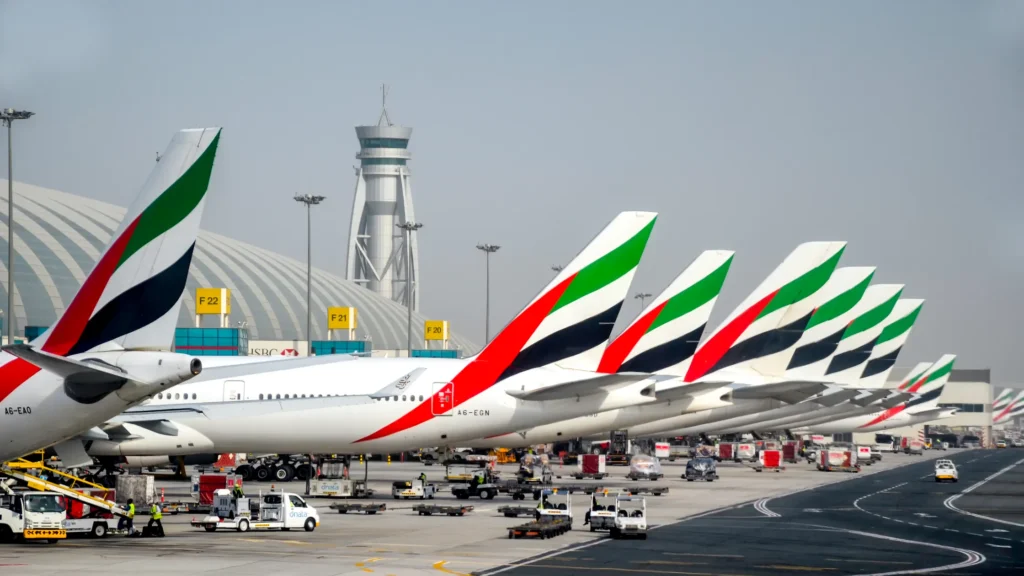
The three main aviation hubs in the region are Doha (Qatar), Dubai, and Abu Dhabi (United Arab Emirates). Dubai is currently the world’s busiest airport for international passenger traffic, handling approximately 95.2 million passengers annually.
Across these three major aviation gateways, more than 195 million passengers transit every year. Viewed as a region, this represents roughly 9.5% of global passenger traffic, with a large majority—about 70% in the case of Abu Dhabi—being connecting passengers who are not necessarily traveling to destinations within the region itself.
The strategic positioning of these aviation hubs is such that all three are geographically located within eight hours of more than 80% of the world’s population, effectively connecting Europe, Africa, and Asia.
To this is added Saudi Arabia’s futuristic Vision 2030 project, which aims to transform the capital’s airport in Riyadh into a global hub for passengers and logistics. With an investment exceeding $30 billion, it is estimated that by 2030 approximately 120 million passengers will pass through this new hub.
Previous Crises in the Region
Aside from the recent COVID-19 pandemic, the last time this region experienced a major disruption to its air traffic was in 2017, when Saudi Arabia, Egypt, the United Arab Emirates, and Bahrain banned Qatari aircraft from flying through their airspace.
This dispute lasted four years and forced one of the world’s leading airlines—Qatar Airways—to divert hundreds of kilometers on every flight in order to avoid those territories. The impact was significant, affecting food imports (at that time Qatar imported more than 40% of its food by air) as well as causing a sharp drop in investment among the countries involved in the dispute.
In total, the blockade is estimated to have caused the State of Qatar a 24% drop in GDP, equivalent to approximately $82 billion.
Disruptions in the Present
Although it is not yet clear how extensive the disruption and economic impact of the current crisis will be, it is evident that the consequences for the region—and for the global economy—will be enormous. Millions of passengers remain stranded at airports across the region, while the surrounding airspace continues to be unsafe for commercial operations.
Major hubs such as Doha remain completely closed, while others like Dubai are operating only limited daily flights, depending on the evolving situation hour by hour. Millions of passengers worldwide who would normally use this region as a connection point between destinations as distant as Los Angeles and Sydney remain stranded in their respective cities or have opted to completely change their travel plans and connect through other regions.
Increasingly, the desperation of regional authorities is leading them to take riskier measures in an attempt to maintain at least some level of traffic. Fellow pilots operating for airlines in the region have begun reporting concerns about some of the decisions being made by authorities in that regard. Others have begun to question whether it is safe for their families to continue living in a region that—while still relatively safe within individual cities—has historically been marked by recurring regional conflicts.
As observers from this side of the planet, all we can do is hope that the situation stabilizes and that international commerce gradually returns to its normal rhythm. Although it may seem distant to us, in today’s globalized economy we are all interconnected. Disruptions of this magnitude on the other side of the world inevitably affect us as well, in one way or another—like a domino effect.
This article was featured in the spanish aviation weekly column “hablan los pilotos” by Francisco Díaz, in the Diario Libre USA edition on March 11th, 2026, link: El profundo impacto al transporte aéreo global de la guerra en Medio Oriente