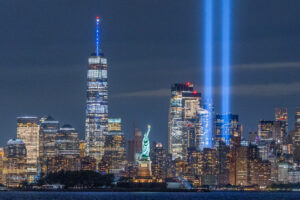
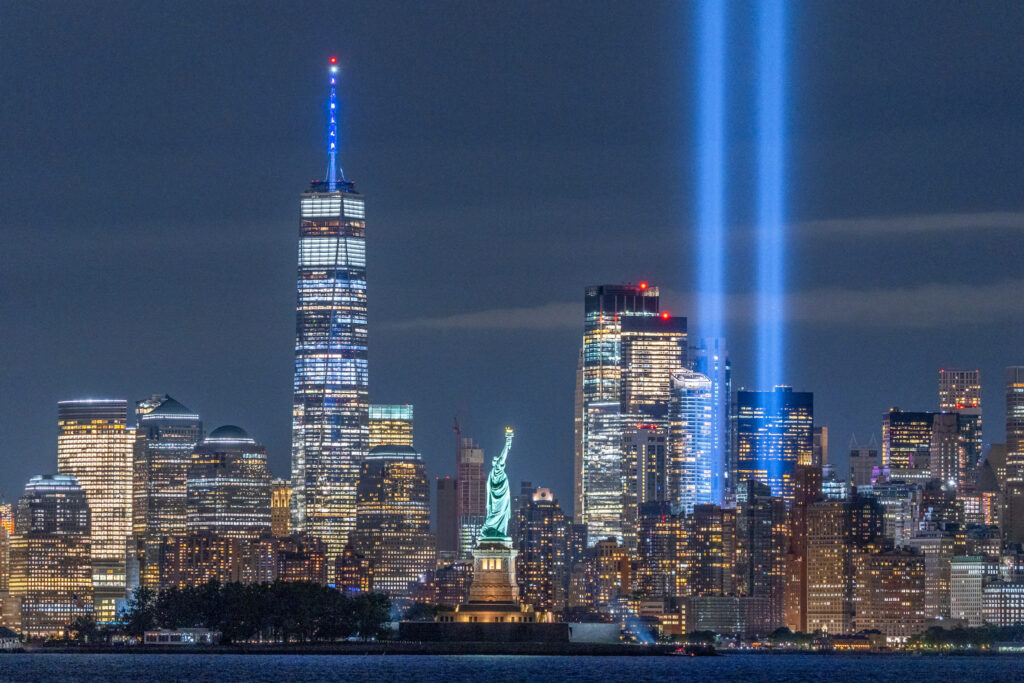
The morning of September 11, 2001, in New York City was a typical late-summer, early-fall morning, with blue, completely clear skies, as the city prepared for local elections for mayor and city council. The civil aviation system was in the middle of an ordinarily busy morning, helped along by the day’s favorable weather, when an air traffic controller at the Boston Air Route Traffic Control Center heard something unusual on the frequency.
It involved American Airlines Flight 11, which had departed Boston Logan International Airport bound for Los Angeles International Airport. As the Boeing 767 was flying over the area near Rome, New York, the controller noticed that the aircraft was no longer transmitting its assigned transponder code. When the controller asked the crew about the code, the aircraft did not respond.
Transponder codes consist of four numerical digits assigned to aircraft operating within radar-controlled airspace, allowing them to be more easily identified on the primary and secondary radar displays used by civil aviation systems. In addition to the numerical code, the system provides information such as altitude and speed, helping controllers and other aircraft determine an aircraft’s three-dimensional position and maintain proper separation from other traffic.
After calling the aircraft several times on the frequency without receiving a response, the controller began contacting other aircraft in the area and asking whether they had American 11 in sight, but none were able to locate it. Then came the unthinkable: someone with a foreign accent could clearly be heard over the frequency saying, “Nobody move. We have a bomb on board. We are going back to the airport.” One of the terrorists who had hijacked the aircraft and taken control of the cockpit had apparently pressed the wrong button while attempting to make an announcement to the passengers and instead transmitted the message over the air traffic control frequency.
What followed was a chain of catastrophic events that continues to haunt us to this day. The aircraft turned south, following the Hudson River from upstate New York toward Manhattan, and ultimately crashed into one of the Twin Towers shortly before 9:00 a.m. In doing so, it shocked the entire world and forever changed the reality of global geopolitics.
Changes in Global Aviation
The September 11 attacks are considered the most consequential event in the history of global aviation security. Although the 1970s and 1980s saw numerous hijackings of civilian aircraft, in none of those cases had an aircraft itself been used as a weapon of war to destroy buildings. Until that day, the recommendation to flight crews in the event of a hijacking was to comply with the hijackers’ demands in order to prevent anyone from being injured. All of that changed on that fateful morning.
Today, the primary mission of pilots on the flight deck is to safeguard access to it. Something as simple as going to the restroom has become an entire coordination process with the cabin crew, who may block the aisle with a service cart to prevent anyone from attempting to enter the cockpit. Major pilot unions, such as ALPA in the United States, have launched public campaigns advocating for the installation of secondary barriers in aircraft aisles so pilots can leave the cockpit to use the restroom without having to rely on elaborate protective procedures.
Likewise, medical emergencies on board have taken on a different significance, as they may now be viewed as potentially staged distractions by terrorist groups intended to cause the cockpit door to be opened and create an opportunity to seize control of the aircraft. Cabin crewmembers today are trained in self-defense and in the use of restraint devices to immobilize passengers, and even the slightest disturbance in the passenger cabin may be treated as a potentially serious threat.
Just as the world changed that day, aviation changed as well, and many say it lost its innocence. Cabin crewmembers went from wearing white gloves to carrying restraints with which to immobilize passengers. Pilots went from welcoming passengers into the cockpit to doing everything possible to ensure that no unauthorized person gains access to the flight deck while the aircraft is in operation.
As an airline captain, this past September 11 I reflected not only in remembrance of the victims, but also on what our industry lost that fateful morning: the innocence of seeing everyone we carry on board simply as customers, and the shift toward having to view them, at least in part, as potential threats.