
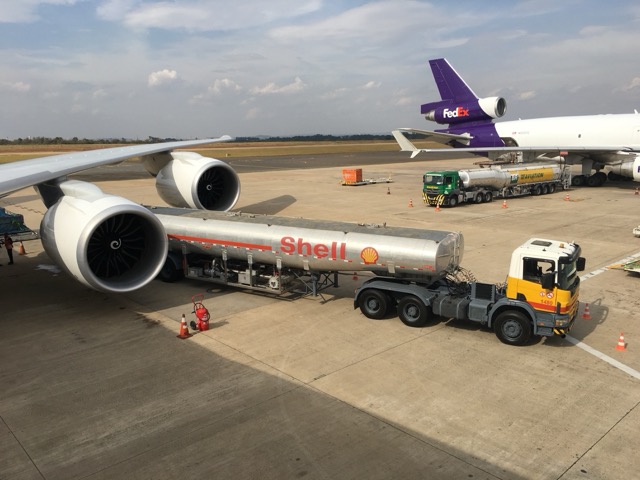
In an interconnected world like the one we live in today, distant problems are no longer truly distant. The war in the Middle East initiated by the United States and Israel against Iran is one of those conflicts that ultimately affects everyone in this globalized world. One aspect of this war that has not yet manifested directly, but threatens to do so, is a shortage of aviation fuel. Although prices have increased, fuel has not yet reached shortage levels, but that may not remain the case.
Air transportation has become the primary means of passenger travel—and increasingly of cargo transport—worldwide. This means that entire economies (such as that of the Dominican Republic) depend on air travel for their survival. In that sense, aviation fuel is the lifeblood of global air tourism and should be of utmost importance to the Dominican Republic.
Global Production
In a normal year without major disruptions, according to the International Energy Agency, global oil refining averages between 83.5 and 85.5 million barrels of oil per day. Of these, around 8% to 10% is converted into aviation fuel, meaning between 7.5 and 8.3 million barrels of jet fuel are produced daily.
It is important to note that jet fuel is a petroleum derivative and requires a highly complex refining process. Therefore, some oil-producing countries are not necessarily jet fuel producers, while some countries that do not produce oil possess advanced refineries capable of producing jet fuel for domestic use and export.
This is the case with major refineries in China, Japan, South Korea, and India, which, despite not being oil-producing nations, are exporters of jet fuel. According to Kpler analyst Matt Smith, these countries import more than 90% of their crude oil from the Middle East, specifically from the Persian Gulf.
In Europe’s case, due to the war in Ukraine and sanctions imposed on its former primary crude supplier (Russia), Europe now imports much of its oil from the Middle East and the United States, along with a mix from African and Central Asian countries, totaling 9.1–9.3 million barrels per day, or approximately 97% of its oil supply. Of this amount, Europe consumes between 1.6 and 1.8 million barrels of jet fuel daily.
Meanwhile, the United States produces about 13 million barrels of crude oil per day, generating various refined products for both domestic consumption and export, with Europe and Asia being its primary export markets. At peak production, the U.S. produces approximately 2.03 million barrels of jet fuel daily, consuming 1.7–1.76 million barrels domestically and exporting or storing around 500,000–600,000 barrels daily, mainly to Latin America and Europe.
Crisis Caused by the War
The closure of the Strait of Hormuz has left approximately 200 crude oil tankers stranded, carrying an estimated total of 190 million barrels of crude oil. This has deprived much of the Asian and European markets of access to a significant portion of their imported crude, forcing them to rely on reserves and seek alternatives from other exporters.
Regarding jet fuel, the global export market normally supplies around 2 million barrels per day, but the crisis caused exports in April to fall to 1.3 million barrels daily—a 30% decrease compared to the same month in 2025. This has placed pressure on European and Asian reserves, bringing Europe’s inventories close to critical levels.
It is estimated that by the end of May, Europe will have less than 20 days of total jet fuel reserves remaining (considered low), and by the end of the summer season—the busiest period for flights—inventory levels are expected to drop below 10 days of reserves (considered critical).
This means that by the fall of this year, if the Strait of Hormuz crisis remains unresolved, Asia and Europe may need to implement fuel rationing programs to avoid shortages.
One of the initial strategies described by Michele Della Vigna, Director of Goldman Sachs EMEA Natural Resources Research, is “demand rationing through price.” In other words, significantly increasing prices to suppress demand and thereby reduce fuel consumption.
As a result, Europe would attempt to balance the loss of Middle Eastern oil access by reducing flights by approximately 15% to align supply with demand. Major airlines such as Lufthansa have already begun this process, announcing the cancellation of more than 20,000 flights for the summer season, contributing to an overall reduction of roughly 3% in European flights.
Response to the Crisis
The United States has played a key role in responding to the oil crisis by supplying a large portion of the crude oil and jet fuel required by Europe, though it has still not been sufficient. As previously mentioned, the U.S. can export about 500,000–600,000 barrels of jet fuel daily, of which approximately 300,000 go to Latin America. However, Europe’s deficit is so severe that, according to the Goldman Sachs report cited earlier, combined U.S. and Nigerian exports cover only about 50% of Europe’s jet fuel demand deficit. This has caused jet fuel prices to skyrocket, reaching double their 2025 levels.
An additional structural issue lies in the type of jet fuel used. While the U.S. primarily produces Jet A fuel, Europe uses Jet A1. The main difference between the two is the freezing point, with Jet A1 having a lower freezing point. Aircraft tanks can contain a mixture of both types, but airport storage tanks generally cannot.
This means that when Europe imports Jet A fuel from the U.S., airports must modify storage systems to switch from Jet A1 to Jet A, often requiring storage tanks to be emptied completely. It is important to note that the Dominican Republic, like Europe, uses Jet A1 fuel.
Storage Capacity in the Dominican Republic
As explained last week, aviation fuel Jet Fuel A (also known as Aviation Turbine Fuel or AVTUR) is a petroleum derivative produced in refineries worldwide. In the case of the Dominican Petroleum Refinery (REFIDOMSA), it imports and refines approximately 2,890 gallons of jet fuel per day (34,000 barrels) and has storage tank capacity for 9,787,554 gallons (233,037 barrels), representing the largest storage capacity in the country.
Meanwhile, the country’s airports collectively have approximately 3.5 million gallons of storage capacity across the seven main airports. Combined with REFIDOMSA’s facilities, the Dominican Republic has total jet fuel storage capacity of approximately 13,287,554 gallons. While this may sound substantial, when weighed against daily consumption and compared with international standards, it reveals a significant vulnerability.
According to data from the Dominican Civil Aviation Board (JAC), the country received approximately 8,700 flights from different regions of the world in May 2025. These included both wide-body and narrow-body aircraft, which together consumed approximately 44.6 million gallons of jet fuel during the month, averaging around 1,486,667 gallons per day. This translates into only about 9 days of total fuel reserves.
International Standards and Preparedness
The International Energy Agency (IEA) recommends that countries maintain aviation fuel reserves equivalent to more than 23 days of total consumption. Falling below 23 days is considered low reserve status, while falling below 10 days is considered critical. This is because crude oil and refined fuel products are generally transported by ship, and shipping delays can take days to resolve.
As our analysis shows, the Dominican Republic, even under the best circumstances, possesses only around 10 days of aviation fuel reserves, placing it in a constant state of critical reserve classification. This means that any delay involving ships supplying crude oil or jet fuel could place the country in a severe supply crisis.
Adding to the concern is the fact that domestic jet fuel refining capacity is only 2,890 gallons per day, while average daily national consumption is approximately 1.5 million gallons. Therefore, local refining alone could not sustain demand in the event of shipping disruptions.
Recommendations
It is evident that the country—like many others after this crisis—must begin investing more heavily in oil refining and jet fuel storage capacity, increasing reserves to more than 23 days of recommended consumption while also establishing contingency plans for potential shortages. These measures include:
First Stage (current international situation)
- Hiring an oil tankers to be used as storage to increase capacity.
- Establishing strategic reserves for the armed forces.
- Improving airspace efficiency to reduce fuel consumption during arrivals and departures.
- Enhancing weather forecasting systems and management of adverse aviation weather to reduce holding patterns, diversions, missed approaches, and similar inefficiencies.
Second Stage (worsening of the crisis by the end of the summer)
- Prohibiting technical stopovers for aircraft refueling.
- Restricting “tankering” operations to other countries while encouraging aircraft arriving from abroad to carry extra fuel into the Dominican Republic.
- Implementing airport slot systems to reduce taxiway delays.
We are facing a global crisis of unprecedented scale. The international civil aviation system is highly interconnected, and a crisis in one region affects the entire system like a domino effect. Dominican authorities must take this seriously by creating interagency and interdisciplinary analysis groups capable of addressing these challenges in the smartest and most efficient way possible.